info@climair-project.eu



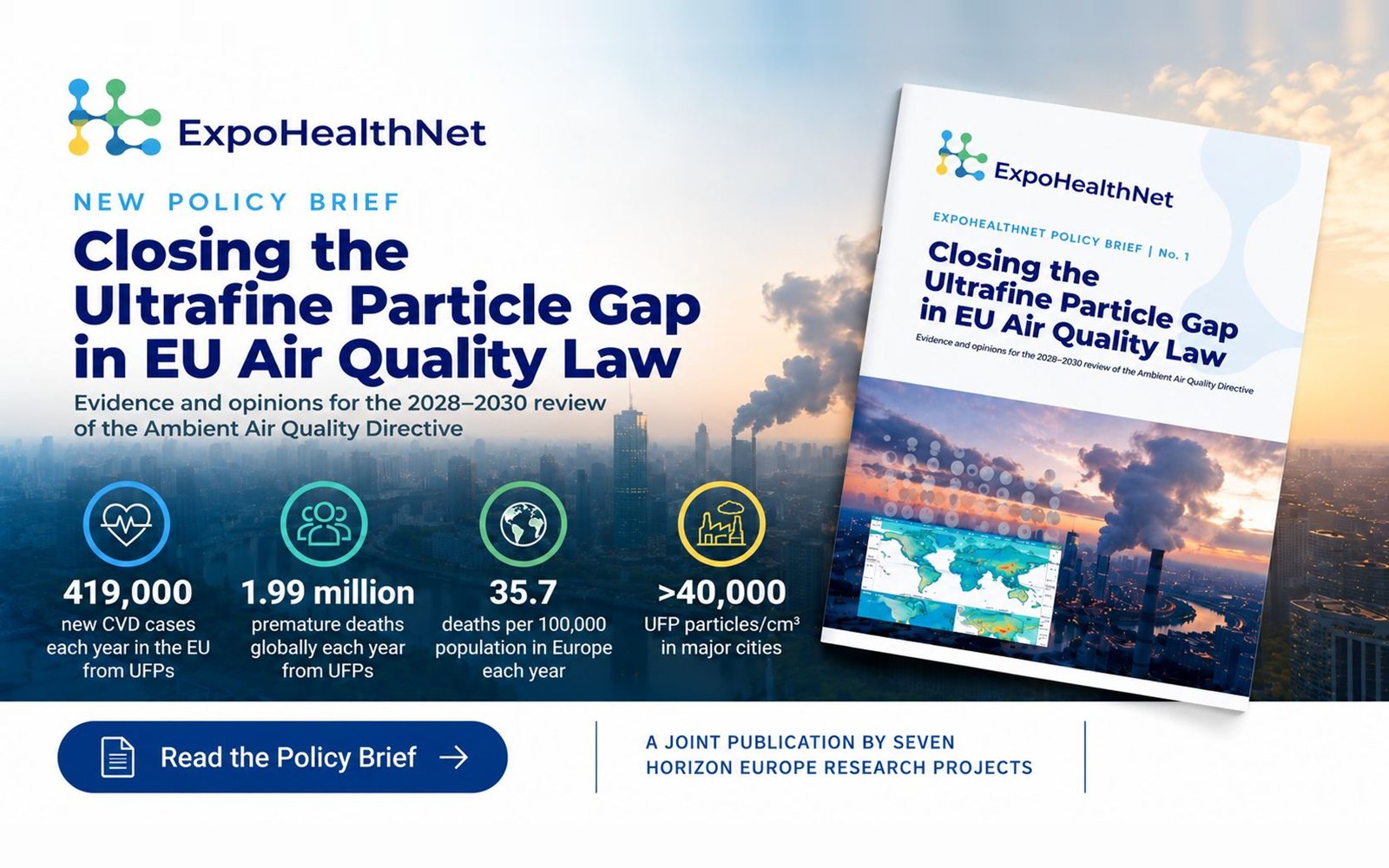
ExpoHealthNet, the European research cluster of which ClimAIr is a member, has published its first joint policy brief, “Closing the Ultrafine Particle Gap in EU Air Quality Law”. It brings together evidence from the cluster’s seven Horizon Europe-funded projects. Its aim is to inform the upcoming review of the EU Ambient Air Quality Directive (Directive (EU) 2024/2881). It is addressed primarily to the European Commission’s DG ENV, the European Environment Agency and Member State environment ministries.
An unregulated health risk
Ultrafine particles (UFPs) are smaller than 100 nanometres and come mainly from combustion in traffic, industry and energy production. Their tiny size allows them to bypass respiratory defences, enter the bloodstream and reach internal organs such as the heart and brain. Close to combustion sources, they account for around 91% of all airborne particles by count.
The brief brings together recent estimates of their impact:
- around 419,000 new cardiovascular disease cases a year in the EU are attributable to UFPs;
- about 1.99 million premature deaths a year worldwide are associated with UFP pollution;
- the estimated annual mortality in Europe is 35.7 deaths per 100,000 people;
- concentrations can exceed 40,000 particles/cm³ in major cities.
Under the revised Directive, UFPs must now be monitored at supersites. However, there is still no binding limit value, target value or exposure reduction obligation for them. The brief also highlights other gaps: the EU’s 2030 PM2.5 limit (10 µg/m³) is double the WHO guideline (5 µg/m³). In addition, limits are set pollutant by pollutant, without accounting for the combined effects of simultaneous exposures.
Four policy options
The brief proposes four legally feasible options, each with three tiers of ambition:
- Extend limit values to ultrafine particles.
- Set a legal pathway towards the WHO PM2.5 guideline.
- Introduce a Cumulative Exposure Index as a reporting tool.
- Recognise Next-Generation Risk Assessment evidence in limit-setting.
All four are grounded in the existing Directive and Article 192 of the Treaty on the Functioning of the EU, so none would require treaty change.
ClimAIr’s perspective: respiratory health and combined exposures
Within ExpoHealthNet, ClimAIr focuses on non-communicable respiratory diseases, specifically allergic rhinitis. The project studies how air pollution, climate change and combined environmental exposures, including fine and ultrafine particles, affect the severity of allergic rhinitis, symptom control and medication needs. It also investigates how pollution modifies immune responses to allergenic pollen, using epigenetic, microbiota, proteomic and metabolomic approaches. Through this work, ClimAIr contributes to research on cumulative exposure, mixture risk evaluation and climate-sensitive respiratory health.
The brief was prepared by ExpoHealthNet’s Working Group 1 – Science for Policy and Practice, with contributions from all seven consortia.
Why now
Member States must transpose the revised Directive by December 2026, and national planning milestones follow in 2028. The Commission must review EU air quality standards by the end of 2030, or earlier if substantial new evidence justifies it. ExpoHealthNet sees the 2028 review as the first legally scheduled opportunity to bring evidence on UFPs, cumulative exposure and vulnerable populations into EU air quality law.
Read the full policy brief: https://doi.org/10.5281/zenodo.22200814
Learn more about ExpoHealthNet: https://expohealthnet.eu/